I absolutely balled my eyes out during my flight back to London after watching the documentary Val (2021), a very intimate and powerful viewing about the life and career of Hollywood star Val Kilmer.
Kilmer had an inventive side to him that started to show very early on and manifested through the lens of his camera, which would be ever present at home and on set, like a trusty sidekick.
Hours of “home made behind the scenes” footage were gathered over the years, bringing this documentary to life by revealing a very beautiful and raw look into the heart and mind of one of the most dedicated and popular actors of his generation.
Assembled and stitched together by the narrating voice of his son, Jack, the documentary takes us on a journey that begins by showing Val’s first signs of artistry at a very young age alongside his siblings, writing and staging amateur plays, recording goofball skits and toying with reality and the abstract via his vivid imagination.
Those early events would eventually lead him to continue developing his artistic vein and take him to Julliard, arguably the most renowned theater school in the world.
By that point suffering from personal tragedy, it was through acting that Kilmer would begin to try and heal his heart, later understanding that it would never be fully healed, but ready to love and embrace other challenges nevertheless.
During that process, Kilmer would reach many places - both physically and emotionally - bringing him much joy and influence over his continued evolution into the spiritual kind human being that he became so well-known to his family and friends.
Those of us on the "outside", however, didn’t really know much about Kilmer despite seeing him in some of the biggest blockbusters in years.
Much of his private life was kept… well… private!
Even having met his wife - a fellow actor - on set, seemed somehow a “discreet” affair.
Many roles allowed him to travel through a plethora of characters and their lives, while setting him the opportunity to work with some of his heroes and even - as indicated before - meeting the mother of his children.
Like any story though, there were plenty of highs and lows, a lot of which really takes us to places where you get to relate or feel a tremendous amount of empathy, as Kilmer provokes you to undergo through some of the most intimate emotions. The need for love, the desire to live passionately, elevated by his fear of death, the struggles to keep balance within your family after loss or deceit, the frustrations of being misunderstood over your own personal passions...
All of which gets examined intimately, as we observe this eccentric, loving and gifted actor reveal a candid side that has been captured on camera and put together through collages like in a scrap book.
An absolute must see documentary, regardless of your own personal connection with the rebel, the entertaining, the mischievous, the only... Val Kilmer!
Based on a novel of the same name, the movie - which was surrounded with tremendous hype since its announcement - lives in a permanent state of horror, like taking us into a nightmare that we just can't wake up from.
In fact, after watching it, it's no wonder to me that the film received an array of bad reviews, with viral posts even suggesting that many viewers across the globe had given up watching after the first twenty minutes.
Before the movie came out, people were very curious to see it, after all, its subject is one of the biggest stars of our time.
With de Armas being cast in the role, it drew even more attention, particularly from viewers like me who were keen to see how she would handle a role of such magnitude.
Given that she had led a career in Hollywood somewhat sheltered from leading roles, to me, she had yet to prove herself and this was certainly her biggest opportunity to do so.
So she did!
Despite the movie's polarizing reviews, one thing seemed to draw universal consensus: Ana de Armas delivered a magnetic performance.
The Cuban actor definitely looked the part!
With make-up, hair, costume design on point and, more importantly, the acting, it really felt like Marilyn Monroe was alive on our screens. Even the accent, which was a point of concern for many, didn't deter the audience from enjoying her performance.
That said, despite being able to acknowledge de Armas' valiant efforts, I came out feeling like I had only seen a one dimensional presentation.
Don't get me wrong, this observation has more to do with how the character was laid out in the script, rather than her ability - for which she deserves plenty of praise - but I wish I had seen more of this character.
See... Monroe's life, as tragic as it may have been, seemed to be escalated to higher levels just for the sake of shocking the audience.
The string of horrifying sequences, the brutally invasive close-ups ("a la" Darren Aronofsky in Requiem for a Dream), the violence - both physical and psychological - was at points too much to handle, offering just one side of a very extremely complex and layered personality.
Sure, that was the path that the director, Andrew Dominik, decided to embark on... but I found that (and more) very questionable.
Dominik certainly made some bold decisions... Some of them work, others are interesting, but for the most part they fail to deliver any meaningful direction to a story that tries too hard to deliver punches in the gut. Where it often tries to address a web of problems, such as the abuse of power and the sexual exploitation of women, it actually ends up being a part of it.
If anything, the movie seems to continue building on excesses that have no place in a cinema room, regardless if you are attempting to be a provocative art house project.
There needs to be a line drawn, particularly when exploring the life of an iconic and troubled character who isn't here to tell her side of the story. That not being the case, it truly feels like exploitive work from Dominik, who seemed to fail grasping the weight of the subject matter.
Not all was bad, as there were plenty of refreshing scenes done creatively, with a switch between aspect ratio and colour grading, often dipping into a beautiful black and white picture. Along the way there are some outstanding transitions that look astonishing on the big screen.
Add to that a beautiful, but often tense and harrowing soundtrack from Nick Cave and Warren Ellis, and you end up getting some good marks to give out...
The highest naturally going to de Armas, who played a tortured soul, who's heart and mind had been plagued mostly by men who abused her throughout her life.
Monroe coveted love, appreciation and approval from these abusive figures, pointing out just how frail she was as someone who dreamt of having a male role model, clearly establishing her as someone who was broken with severe "daddy" issues.
While I understand that this, and other painfully intimate details, are a quintessential part of Monroe's life, it all felt very gratuitous at points - including the various nude scenes - during the exceedingly long run-time of 2h46m - that at a certain point had me doubting its artistic value.
In a nutshell, Marilyn Monroe didn't get the movie she well deserved. Instead, she got a horror show that depicted her as an inanimate object living in a man's world, stripped of any shed of humanity and dignity.
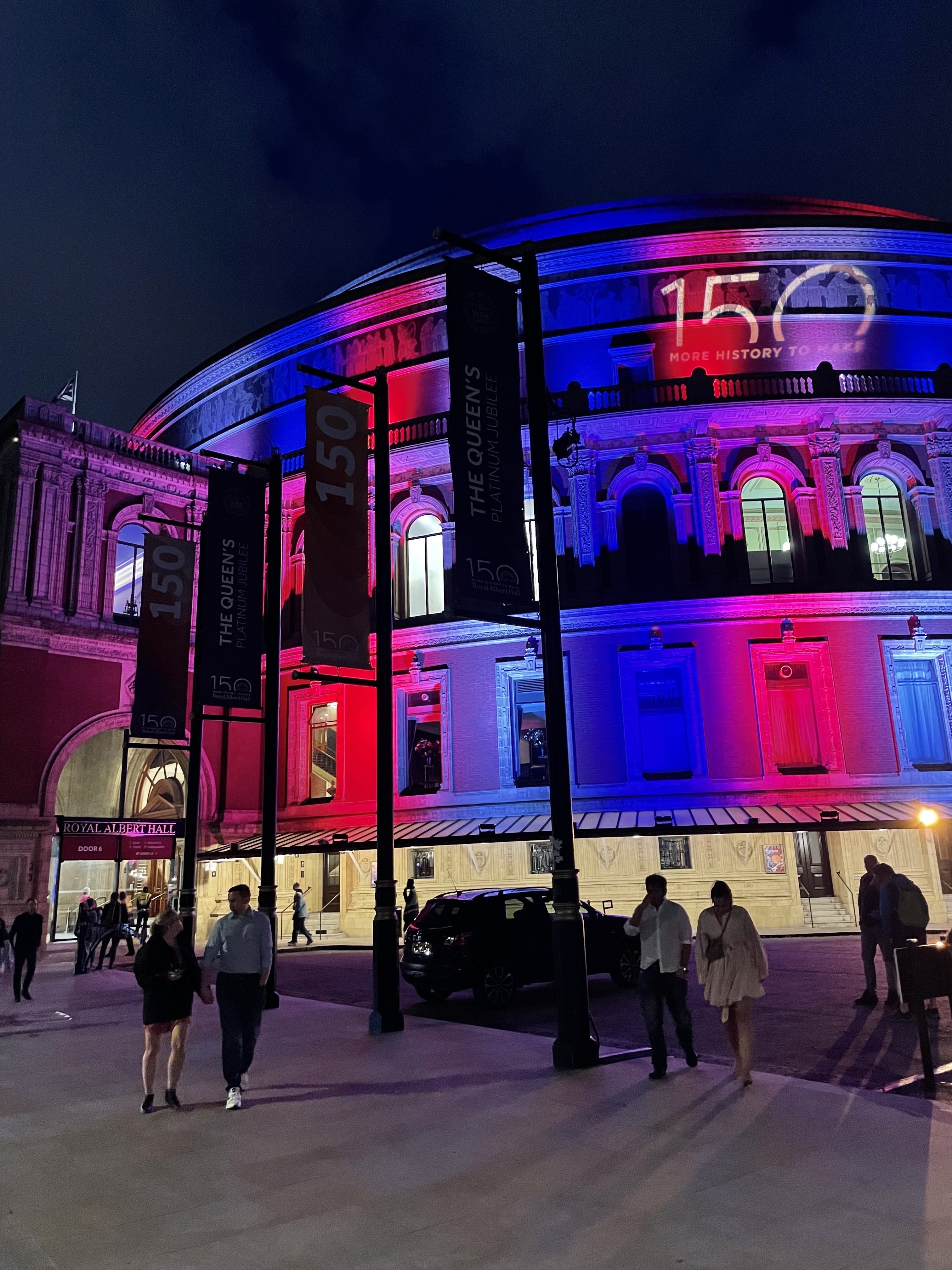
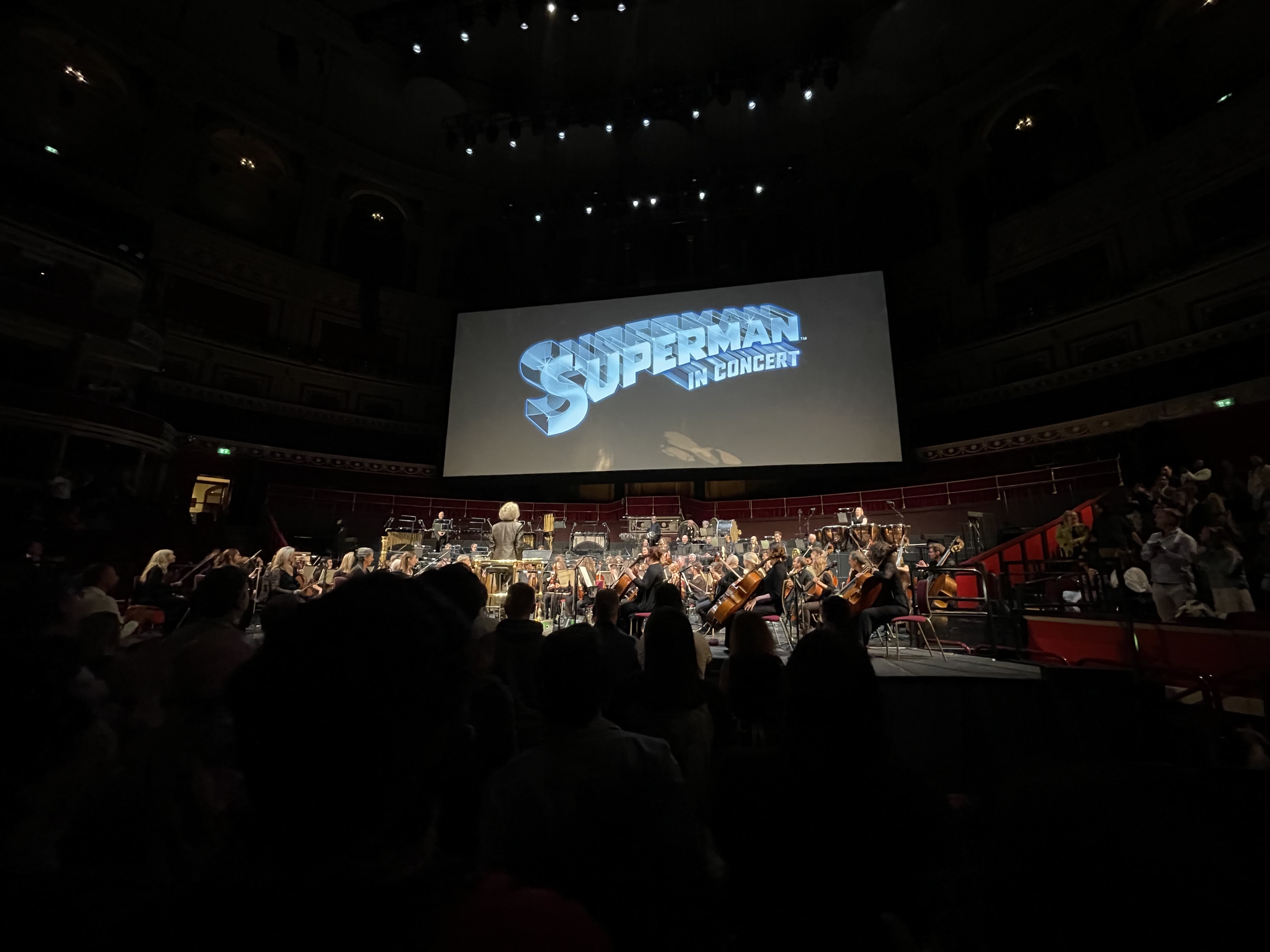
Last night I finally went to see Superman in Concert, in
which the London Symphonic Orchestra played the iconic John Williams
soundtrack, as the 1978 movie played on the big screen, purposely placed at the
majestic Royal Albert Hall in London.
It’s a movie that I have seen hundreds of times as a young
kid and in my adolescent years, but never did I have the opportunity to see it
in the big screen... let alone with the music being played live.
I can't quite recall how I was first introduced to the
character or the cartoons themselves, but I’m pretty sure my Dad had something
to do with it, even if just by following the logic that it was in his house
that on early mornings I would take up the living room and emulate everything
I saw on TV, including stretching out both my arms as I pretended to fly (even
at one point donning the costume for that effect).
That’s why, for yesterday's special evening, I decided to
take my Dad along with me, by wearing his watch and a double breasted blazer I
inherited from him. I should have brought a tie too (Dad was of the opinion
that a man should always look his best and wear a tie), but that detail only
occurred to me later.
As cheesy as it may sound, I somehow felt his presence as I
rewatched one of my all-time favourites, this time as an adult.
Last night also provided me the chance to introduce Richard
Donner’s timeless classic to my girlfriend, who had patiently (and I mean
this!) heard me talk about the character and watched several videos about
Superman, Christopher Reeve or the making of the movie.
I was confident she would embark on this journey with an
open mind and an open heart...
The movie, being a big product of the late 70's, had various
elements that already piqued her interest. From the star-studded cast (including
the likes of Marlon Brando and Gene Hackman), the iconic soundtrack (with the
added bonus of being played live), the Mario Puzo (of The Godfather
fame) writing involvement, the dominant presence of Reeve's legacy and the
production value of a big-budget movie for that time.
Most of all, I felt that being introduced to something that
I deeply cared about had already made the evening special before it even began.
Sure enough, as I flew through memory lane, I learned new
things and caught fresh details that I had not noticed or understood before
during my younger days of watching that run-down BETA tape (also known as Betamax).
Feeling privileged to have such an opportunity, with good
seats at such a cultural staple and surrounded by many, who like me, are massive
fans of the movie and comic books (many in attendance came with some sort of
Superman merch, some even in full costume) it made this night one for the ages.
From the opening credits right til the very last frame, I
was gripped to my seat and fully aware that a dream of mine - no matter how
small or silly it may sound - had been fulfilled in that moment.
Maybe that same awareness was the trigger that made me
emotional several times, in moments that I had not been emotional before.
I don't know.
All I can say is that I felt that room feeling
incredibly grateful and hoping to one day share this movie with kids of my own.
Here's this year's top 10 movies, albums and tracks of 2021.
As ever, this list is naturally limited to what I've seen and heard.
For instance, there's plenty of films that I haven't been able to see, therefore they were not in the running. Licorice Pizza, C'Mon C'Mon, The Tragedy of Macbeth, Hand of God, Boiling Point are just a few...
But just so everyone knows... there are quite a few that are many people's favorites that I've decided to have off the list: Belfast, Don't Look Up, Spencer, No Time to Die, Tick Tick... Boom!, The French Dispatch and Suicide Squad are just a few. Some almost made the cut, while others were just disappointing given the expectations.
MOVIES
Spider-Man: No way home West Side Story Dune Pig Green Knight Judas and The Black Messiah King Richard The Last Duel The Power of The Dog Drive My Car
ALBUMS
Sufjan Stevens & Angelo de Augustine - A Beginner's Mind Sam Fender - Seventeen Going Under Little Smiz - Sometimes I Might Be An Introvert Tyler, The Creator - Call Me If You Get Lost Olivia Rodrigo - Sour Clap Your Hands and Say Yeah - New Fragility Sonic Silk - An Evening with Silk Sonic J. Cole - Off Season Arlo Parks - Collapsed in Sunbeams Doja Cat - Planet Her
TRACKS
Sam Fender - Dying Light Garrett Mahoney - Italics Sufjan Stevens & Angelo de Augustine - Back to Oz Jose Gonzalez - El Invento Kings of Convenience - Rocky Trail Jorja Smith - Burn Clap Your Hands and Say Yeah - Innocent Weight Future Islands - Peach Justin Bieber - Peaches (feat. Daniel Ceasar & Giveon) Kanye West - Junya
Really sad to hear about the passing of Jazz veteran Barry Harris at the age of 91 on Thursday, December 8th.
Harris, an accomplished jazz pianist, had played with legendary musicians such as Miles Davis, Cannonball Adderley, Dexter Gordon, Sonny Stitt, among many others.
Grounded in the sounds of bebop, Harris would eventually be featured in 2000 on a documentary about his career named Barry Harris - Spirit of Bebop.
Having established himself as one of the greats, it's no surprise that Harris would be awarded in 2000 in the American Jazz Hall of Fame for Lifetime Achievements & Contributions to the World of Jazz, a milestone that serves to establish his legacy within the cultural scene...
Being such a prominent name in the music scene, I feel very fortunate to have had the chance see him perform live back in 2011, after I was given three tickets to attend his gig at the Pizza Express Jazz venue in London.
The opportunity came after Portuguese jazz critic Jose Duarte had to give away his tickets due to unpredictable circumstances that made it difficult for him and his family to travel into the UK.
Gutted for not attending, particularly as as he was making the trip just to see legendary jazz pianist, Jose Duarte was advised by my Dad to pass on the tickets to me as to not have them go to waste.
Dad called me and asked if i was keen and went on to say that he had hired Harris to play in Portugal many years ago, while also adding that this was a chance of a lifetime as he was likely going to stop touring in Europe due to his condition.
I must confess I knew nothing about Harris - which likely prompted by Dad to be upset at me - but felt very flattered and privileged for the opportunity. I took those tickets and invited two friends of mine from CNN to attend it with me.
The gig, as you would expect from such an icon, was superb. Playing in front of a sold out venue, I recall feeling his presence in the room and within each note that he played, despite the constrictions that came along his age. Even addressing the audience seemed like a hard task... but not when he was hitting those notes on the piano. That looked and sounded effortless.
At the end of the gig i approached Barry and introduced myself. Said my Father was Duarte Mendonca, who organised Estoril Jazz in Portugal. Instantly memories started flooding in and we ended up sitting down and having a chat about those days in Portugal. By the time we start wrapping up the conversation, I ask if he doesn't mind taking a picture so i could show it to Dad. Harris greeted my request with a smile on his face and boom. Picture taken. What a moment!
I don't remember exactly what went down after that, but I probably must have spoken to my Dad the following day, telling him all about the gig, my chat and the picture - which I would have eventually send via email to him.
To my surprise, that same picture would be printed in a decent size and placed on my Dad's work desk...
More surprisingly though, the picture would also be featured in the jazz program for the following year's festival.
I was always incredibly proud of that, as i knew Dad was too. In same ways was just another confirmation that his love for music was living through me and that gave him a sense of mission that had been completed...
I guess in many ways, this is as much of a tribute to Barry Harris, as it is to my Dad...
May both reacquaint themselves again through their love of music... Maybe Dad will tell him all about the picture he had in his office...
Fun fact: this was the song by Vince Guaraldi that prompted Peanuts producer to approach Guaraldi to compose the soundtrack for the
unreleased 1963 documentary A boy named Charlie Brown. It was there
that the later designated theme song Linus and Lucy would come to
fruition.
It won the
1963 Grammy for best original jazz composition. It was taken from the 1962 album Jazz Impressions of Black Orpheus, which drew inspiration and played
tribute to the music from the 1959 Brazilian / French / Italian production Black
Orpheus, containing some of Brazil’s bossa nova royalty in its
soundtrack.
Soon
after my Dad’s passing in August, the family started making plans to
bring over his ashes to the family tomb in Olhāo, so that we could place him
together with his Mother, with whom he always said he wanted to be
"reunited" after she passed away at a very young age. Dad was 23 at the
time and that life event had a profound effect on him, given their
special bond.
As we started to make plans, I asked about his life in the Algarve.
Even though Dad was born in Lisbon, his side of the family was based in Olhāo where he lived for several years.
I
was told Dad lived in this big house, now abandoned and covered in
murals, which made it hard to miss. On top of that its architectural
style made it standout and a well-known spot in the city.
I shared the screengrab with my two brothers who immediately recognized the place.
“We drive past it all the time,” said my brother Alex.
Olhāo
is right next door to Tavira where my Dad's side of the family has
spent their holidays over many years, so naturally, bumping into that
place was to be expected.
It's
September and I'm days away from going to Tavira, where I decided to
take a morning to go on a road trip with my girlfriend, where we would
first go to the house and then to the cemetery where my Dad’s family is
at.
In
the 25/30 minute drive from Tavira, I could feel some anxiety building
up. I felt like we were off to an adventure, searching for fragments of
my Dad’s past, which were soon to be part of my own story.
As we arrived, we could see the house from a distance. It stood out in such a way, that it felt like it didn’t belong!
We
parked the car and took a moment to look at it before crossing the road
and walking all the way around, looking at each detail and admiring
every little corner. We took particular notice of the mural of a witch, which the "pointed roof" took the shape of her hat.
We
looked for an entrance, but most of it was blocked, only a small
entrance off the side in which you would need to crawl under. I didn’t
have the courage to do so, as it didn’t feel safe. I started taking
pictures, both wides and close ups.
I
handed over my phone to my girlfriend and asked her to take a couple of
stills of me standing on the front and back of the house. It all felt
surreal.
I saw a mailwoman speaking to another lady and approached them to ask if they were locals and knew anything about the house.
The
mailwoman says she is from somewhere else (Faro, perhaps?), but the
other lady instantly says that despite not being originally from the
area, she has lived there long enough that she can help.
I
asked her about the house and she says that it is known as “Chalet
Victoria”, owned by the wealthy family "Saias" for many years,
before it was sold to the city hall. But before any of that happened, it
used to be the property of businessman José Guerreiro Mendonça, my
great-grandfather, who had purchased the place from an Italian emigrant.
There he lived with his family, including his son Francisco Xavier
Mendonça (my Grandfather), both of which worked for the national bank
(Banco de Portugal) until the financial crash happened and they went
bankrupt.
As a consequence, they had no choice but to sell the house.
We
were in awe of this story, delivered with a great level of detail, to
the extent where she almost sounded like the local historian.
As
we thanked her and said our goodbyes, Carolina pulled out her phone and
went on Google to look the story up. Everything checked out.
We made our way to the cemetery to pay a visit to the family tomb and wrap up our morning.
Moments
later, I call my stepmother to tell her about our morning and how
everything we heard matched her version of the story except for one
thing. She believed the house was rented, but apparently our family
owned it and after selling it due to the crash, they lived in it as
tenants for a few more years before moving to Cascais.
Cascais,
I was told, was already a very dear place to my Dad’s family and due to
their long history and affection with the small village on the coast of
Portugal, my Dad would end up there as an adult, building his house,
starting his involvement with the jazz festivals and spending his days
there until his passing.
But his story begins in Olhāo, at a place unknown to me until now.
Filling
in those gaps and learning more about his life made me somehow closer
to him and offered me a physical and spiritual place that I can come and
visit whenever I’m down at the Algarve. It also provided me with
memories that I certainly won’t forget, tangled with this unfamiliar
sense of adventure and discovery.
It
felt like a great day, that I couldn’t help myself but make the
headline of this post “A Great Day in Olhāo”, after the iconic Esquire
picture “A Great Day in Harlem”, taken by Art Kane.
That picture, which
features some of the greatest jazz musicians of that time, has its own story with Dad... a story that like this one, I will continue to cherish
with all my heart and to remember each time I go back to my Dad's
place, as it continues to back hanged on his wall.
On Friday we lost one of the most musically gifted minds in showbusiness, Mr. Stephen Sondheim.
An all-time great, Sondheim's creative, insightful and sensitive soul created a body of work that will long live throughout history.
Only a few years ago was I awaken to his great collection of classics, due to my recently gained interest in the field.
I say recently because it took me years before I started liking musicals, which may come as a shocker to some given my interest in music, cinema and theatre.
Sure, growing up I had watched classics like My Fair Lady (1964) and The Sound of Music (1965), but they never really stucked with me.
It was only TheBlues Brothers (1980), All That Jazz (1979) and later on Moulin Rouge (2001) that I loved... So, It would be fair to say that I felt a certain lack of interest in watching anything within the genre.
It was only after coming to London and seeing them on stage that I started to become infactuated with the musical genre.
Since then, I've seen a variety of musicals such as The Lion King, Les Miserables, Phantom of the Opera, Waitress, Book of Mormon, Hamilton, among others... Within the many I've seen, two of Stephen Sondheim's masterpieces took my breathe away: West Side Story (which I only saw on TV during the pandemic) and Company (appropriatly I saw it at the Sondheim Theatre in London just a few seats away from Sir Ian McKellen).
West Side Story naturally became an instant classic in my eyes, due to the great pairing between Sondheim's lyrics and Leonard Bernstein's music... But it was Company that would later have a resounding effect in my life.
In many ways, its main character, Bobby, was someone that I could relate to, particularly when we reach the tune Being Alive, Sodheim's best song in my humble opinion.
I've heard many different renditions of that song.... From Neil Patrick Harris to Raul Esparza... even Adam Driver took a crack at it in Noah Baumbach's Marrige Story(2019)... All of them great, but one standsout the most... and that's Dean Jones.
It's a version that I've shared and talked about many times [1][2]... and what better time and reason to share it again than as a way to celebrate Mr Sondheim's legacy.
As I draw this post to an end, I would would also like take this opportunity to do two last things:
Remind those in London that Sunday in the park with George, another of Sondheim's great works, is hopefully coming to London in 2022, after it was cancelled due to the pandemic. This particular reannactment will star Jake Gyllenhaal and Annaleigh Ashford in the leading roles.
And finally, to encourage everyone to watch this celebration of Sondheim's 90th birthday, Take Me to the World: A Sondheim 90th Birthday Celebration.
No Time to Die (2021) has finally been released
in the cinemas, after consecutive delays due to the pandemic.
It was worth the wait!
Sure, it may not be quite at the same level as Casino Royale
(2006) or Skyfall (2012), but nonetheless a much needed upgrade from the disappointing Spectre (2015).
But more than its ability to bounce back from their latest
entry, it served as a great swan song for both James Bond and Daniel Craig in this
series.
For over 15 years and across five movies, we’ve been able to
witness something which we haven’t seen before: Bond’s character arc.
Since 2006, we have had a level of continuity across all motion
pictures which felt like uncharted territory. Whereas other films before Craig seemed to always present Bond as a finished product, with Craig we saw a development of the character, as well as the world he lives in.
In the first film,
we see a depiction of a very young and raw James Bond as he made his mark with
MI6. He falls in love and gets betrayed and heartbroken, thus explaining the beginning of his trauma and his difficulty to trust people.
The narrative serves as a catalyst for the sophomore entry Quantum of Solace (2008), where we see him on edge and on a quest for vengeance.
“Shoot first, ask questions later”, seemed to be his motto…
Some people didn’t like this as it seemed the most recurrent
criticism to the sequel in Craig’s Bond era. Bond came off as brute,
putting on his muscle and showing very little elegance and class. That,
however, feels to me like it was the intention… The point was to show a very
fragile Bond in the making, as he processed all these emotions through his
drive in getting back at the people that led to the death of the love of his
love.
Skyfall goes on to explore Bond’s character, by
offering us glimpses of his past, while also setting up Spectre, the evil organization behind the main occurrences in previous films.
This would of course be the subject of the fourth film of the series, one that
ended up being the most disappointing given storyline, the historical meaning
behind it, the cast and the success of Skyfall setting it up.
Overall, the
expectation was quite high and it failed miserably. You can’t help but wonder
how they messed it up so bad, when there was so much juice to squeeze out of
it.
And then we have No Time to Die.
As I started by saying, it is a large improvement over its
predecessor, bringing back full circle the character development we’ve been
seeing over the years.
The emotional depth on this latest and final entry was
something that had never reached this kind of level, prompting actress Léa
Seydoux to say that she even cried when watching it. Seydoux, back for her
second film in the Bond saga, was at the centre of No Time to Die – a film
that seemed to bring more women to the spotlight. Ana de Armas’ scene in Cuba
was terrific and left audiences asking for more, while Lashana Lynch iteration
of the “new 007” showed us she could have easily carried the movie by herself.
Need to also mention Ralph Fiennes’ take on M, which for the
first time since he took on the role, put his acting skills on display and
Jeremy Wright as Felix Leiter, who delivered one of the most important scenes
in the film.
On top of great character development, good addition of
characters and acting, the 25TH Bond film delivers on all the elements that
have made the franchise so popular.
Beautiful scenery (Italy never looked as good like their
display of Maratea), great sense of style (I want to buy the entire Bond
wardrobe, but the tan suit standout)), classic one liners (some of them good,
others not so much), camp moments, gadgets, chase scenes, plenty of action and - to my surprise - a good theme song from Billie Eilish.
Oh, and lots of nods to the Bond movie legacy and his
writer, Ian Fleming.
But it came with its flaws… many flaws!
Rami Malek’s Lyutsifer Safin was – alongside Christoph
Waltz’s Ernst Stavro Blofeld – a total dud.
Aside from the opening act, the main antagonist never really
posed a threat, played into all the silly cliches and just overall fell flat.
Some of the dialogues were painful to witness, from his motivation to his
exchanges with Bond.
There were plenty of incoherent scenes which prompted me to
think that we were going down the same “silly” route as the older movies.
Specifically where the villain has the upper hand but gives that away in the
name of stupidity. Quite honestly, it’s hard not to react as I find these
insulting to an audience member… even if we are asked to suspend our disbelief.
“Before I kill you Mr. Bond… let me tell you all about my
secret plan” – It wasn’t quite this, but it felt like it at points!
There were other small moments… lines that didn’t work,
scenes that seemed to oddly escalate or others that could have used better
acting direction.
Oh, and a word on the duration. There was absolutely no need
for it to be this long. Could have easily shaved 20 to 30 minutes.
I just wished the movie was just a little bit more... tidier.
(See what I did there?)
Nonetheless, despite this small wave of criticism, it
still wasn’t enough to detract us from a great send off to both Bond and Daniel
Craig as they deliver their final and very emotional goodbye to the big
screens.
Looking forward to seeing where producers will take the
character next.
What sort of adventures will he embark on?
How will they make
the new series standout?
But more importantly, who will take on the mantle of the
most iconic spy ever to grace our screens…
Let me be upfront with you: This is not a groundbreaking documentary, but rather one that primarily serves fans such as myself.
With that said, there are still lots of benefits to those who are not as interested or acquainted.
The story-telling that takes us through the origins of Superman and the development (and redevelopment) of the character - while carrying us through the history of the world through that time - is done in a way that easily captures the attention of comic book fans and curious minds alike.
Throw on top of that the archive footage, the John Williams monumental soundtrack (the track Planet Krypton is a personal favorite), some intimate interviews and there's an emotional connection that goes straight from my upbringing, all the way up to adulthood.
If this is news to you, then let me clue you in:
Outside of my family, I have a few selected heroes, in which Superman is one of them!
Yes, I have it in for a fictional character at the age of 36.
I guess that, like many of my "distant" real life heroes, such as Tom Hanks and Mr. Fred Rogers, Superman shares the same core values, always upholding moral principles, standing for truth and justice. These have been passed on to me by my mother in particular and later on nurtured by many elements, including motion-pictures and comic books.
Created in 1938 by Jerry Siegel and Joe Shuster - both sons of Jewish emigrants - these two American teenagers from Cleveland, Ohio, helped shape the notion of what a superhero is.
Combining "god given" powers with human-like qualities, Superman gradually became a success in households across the US and later the world.
Since its genesis, "The Man of Steel" has taken many forms and crossed several platforms.
From newspaper clippings, comic books, radio shows, animated cartoons, a Broadway musical, live-action TV series, video-games and motion-pictures.
Out of all these mediums, I'm not quite sure which one was the first to hit home for me...
I have recollections of watching the 1966 cartoons The New Adventures of Superman, while clenching my fists, stretching my arms and saying "Up, Up and away" as I pretended to fly.
"Faster than a speeding bullet", the "Son of Krypton" was unsurprisingly becoming a personal favorite, to the effect that I started dressing up in an improvised Superman costume at the age of 7.
I can almost feel my tiny feet absolutely lost in those massively big red wellie boots that we had lying around the house.
But it was sometime before my teenage years that the hero also known as Kal-El would have a resounding effect on me, as I watched - with more mature eyes - the 1978 Superman: The Movie.
Directed by Richard Donner (who was also simultaneously filming the sequel), with a script by The Godfather famed writer Mario Puzo, the movie starred in its illustrious cast well respected names in the industry.
The headline name was movie icon and Academy award winner Marlon Brando, who was strategically approached to play Superman's father, Jor-El, so he could attract big crowds to the cinema theaters.
Brando was reportedly made the world's highest paid actor at the time, having received a whopping $3.7 million for two weeks of work, despite very limited screen-time. The other top-billing name was award-winning actor Gene Hackman, famous for movies such as The French Connection (1971) and The Conversation (1974).
It was, however, the name Christopher Reeve that would fly highest across cinemas, living rooms and people's imagination. The then unknown Julliard alumni soared to stardom and made audiences across the globe believe a man could fly.
Much to that effect, was the late Richard Donner's vision and work ethic, who always employed verisimilitude - "the appearance of being true or real" - in his cinematic approach.
The story had to have its own honesty. Everybody had to believe it was real, Donner said in a behind-the-scenes interview.
Speaking about "Dick" Donner's ability as a filmmaker, Superman's creative consultant Tom Mankiewicz (Herman Mankiewicz's nephew) said:
Dick has a talent, because of the things that are in him him as a person. He wants to believe in those myths and when you can make an audience believe that what's happening on the screen, even though its totally extraordinary, that this is actually happening... that's when you have verisimilitude!
Yet, that same ethos could only be fully executed if acted by the right performer that truly embodied the same vision as the director.
Reeve did just that and then some, taking it beyond what was ever expected.
He became instantly my favorite personification of Superman - a thought shared by many, over future generations.
Never, in any platform, has someone embodied so flawlessly the essence of both Superman and his "mild-mannered" alter-ego, Clark Kent.
Even if the dual-character portrayal asked audiences to suspend their disbelief for a man who all of the sudden becomes unrecognizable by just removing his glasses and changing up his hair, that was only made possible by Reeve's acting ability, who made it believable for the audience that no one would ever suspect that both could be the same person.
The scene alone in Donner's first film, where Clark attempts to reveal his true identity to Lois Lane is one for the ages.
The body language, the change of tone... all done in such a subtle manner, really captures the biggest challenge when playing that character.
In an interview, Reeve spoke about how he approached his role:
What makes Superman a hero is not that he has power, but that he has
the wisdom and the maturity to use the power wisely. From an acting
point of view, that's how I approached the part.
Trades that Superman would also use while taking on his Clark Kent persona, who works as a journalist for the "Daily Planet".
Evidently, this isn't a coincidence.
Working in news allowed Kal-El / Clark Kent / Superman to always be a step ahead of the general public by getting breaking news first, but I like to believe, his job also gravitated towards the notion of serving the public with the truth, while also holding powerful people accountable - exactly as he would do as Superman.
Interestingly enough, it was through Superman (and Tintin) comic books that I got interested in journalism as a kid, never imagining that one day I would turn out to be one.
Anyway... I digress.
Back to the documentary...
My favorite sections - unsurprisingly - revolve around every time Reeve's name is mentioned.
Not only did he bring to life a character that had me inspired from a very young age, but also Reeve revealed himself to possess a lot of trades that I very much admired and even saw in myself.
A few things stood out to me over the years...
Reeve had a knack for being brutally honest, even if that meant creating some possible tension. Nothing seemed more important than telling the truth, or at least, his version of it.
He also came across as someone who was guided by a moral compass that would lead him into doing what he thought was right. That could be by simply being honest about his feelings and motivations or taking on social causes such as the environment.
His love for the arts was truly a standout. He often would talk about literature, painting, cinema, but it was the passion for his performing craft that really moved Reeve. Acting meant the world to him and there was very little room for compromise if that meant getting in the way of delivering the best performance within his reach.
There is some interesting archive that pretty much encompass all the things mentioned above from interview segments where he talks about working with Marlon Brando, acting tips and skills and his take on how Hollywood studios have often tarnished essential artistic components over profit.
Having said all of this, the bar was set - and it was high. I was both in awe of Donner's Superman and the man that played it.
This would often lead me into an internal dialogue about who stands out more as a hero of mine: The character or the actor?
I have come to the realization that they are one and the same, with history showing us that Reeve was the real-life Superman.
In 1995, the actor embarked on his toughest battle to date, after a life-altering accident that left him paralyzed from the neck down.
But even during his darkest times, Reeve found the energy to keep going and expanded on his work as an activist, by campaigning and investing in stem cell research, while advocating for better insurance coverage for people with disabilities through The Christopher and Dana Reeve foundation and the Reeve-Irvine Research Center.
Through a lot of courage, persistence and support, Reeve's pioneering work would break down what many deemed as controversial walls and paved the way for new methods and technology that would allow people to dream of walking again.
Worth watching Reeve's final public appearance in June 2004, where he spoke about some of his battles and accomplishments through their foundation.
It had become clear that the love Reeve poured onto others, was given back many times more over the years.
From the day of his accident, all the day up to his passing, many moments have taken place.
His appearance at the 68th Academy Awards in 1996 is one of those standout occasions.
Another compilation of moments that I will never forget was the reaction across the globe
when Reeve passed away on October 10th 2004, just 15 days after his 52nd
birthday.
I was in awe of the way people celebrated his life and legacy.
Tribute TV packages and interviews, including with some of his close friends, like Robin Williams - who had shared a dorm room with Reeve during their time at Julliard.
Newspaper cartoons were a personal favorite, with so many of them truly echoing Reeve's true nature.
I guess by now you can clearly see how Reeve continues to have a resounding effect in me.
Simple proof is how what initially started as a mere post to share the documentary, has become a small essay on Superman and the man that turned him into a true icon to millions around the world; and as I read back some of the lines I've written, I know in my heart that none of it is doing justice to either the character nor the actor...
But even with that said, I cannot control the urge and stop writing. There is
so much more I could be saying and writing, but don't want to continue drifting away from the documentary.
If you are remotely interested in any of this, you should definitely give it a go. If anything, you will get out of it with a larger sense of one of the most iconic pop-culture figures of our history.